Device Insights
 Security and navigation
PERMISSIONS Refer to Device Insights in Permissions.
NAVIGATION Devices > All > click the hostname of a device > Device Insights
NAVIGATION Devices > click the name of any previously accessed device > Device Insights
NAVIGATION Sites > All Sites > click the name of a site > click the hostname of a device > Device Insights
About Device Insights
Device Insights is a Kaseya Intelligence-powered feature built into the device summary page that allows technicians to interact with device data using natural language prompts. It brings together and contextualizes information such as alerts, patch management, hardware audits, installed software, and activity logs into a single, prompt-driven interface. To learn more about how we use AI, refer to AI Capabilities in Datto RMM.
Known limitations during early access
The Device Insights feature is currently available for Windows OS devices only (workstations and servers). Support for additional operating systems will be added in future releases.
Device Insights can query the following data areas on the device summary page. Support for more data areas will be added in future releases.
| Data Area | Availability |
|---|---|
| Summary | Yes |
| System | Yes |
| Patch Management | Yes |
| Patch Policies | Yes |
| Alerts | Yes |
| Policies | Partial — Software Management policies only |
| Monitors | Yes |
| Software | Yes |
| Memory | Yes |
| Storage | Yes |
| Related Devices | Yes |
| Activities | Yes |
| Network | Yes |
| Metrics | Yes |
| Notes | No |
| UDFs | Yes |
| Security | Partial — Antivirus status and product only |
Accessing Device Insights
- Follow any of the navigation paths in Security and navigation to open the device summary page.
- At the top of the page, click Insights.
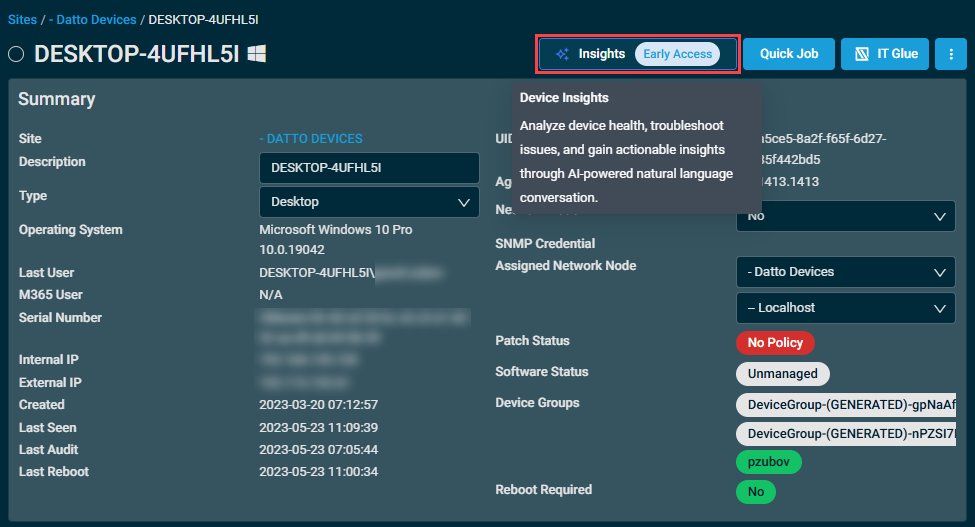
- The Insights interface loads in the main content area, presenting the prompt selection panel.
The Insights interface
The Insights interface is divided into two areas: the prompt input area at the top and the prompt selection panel below.
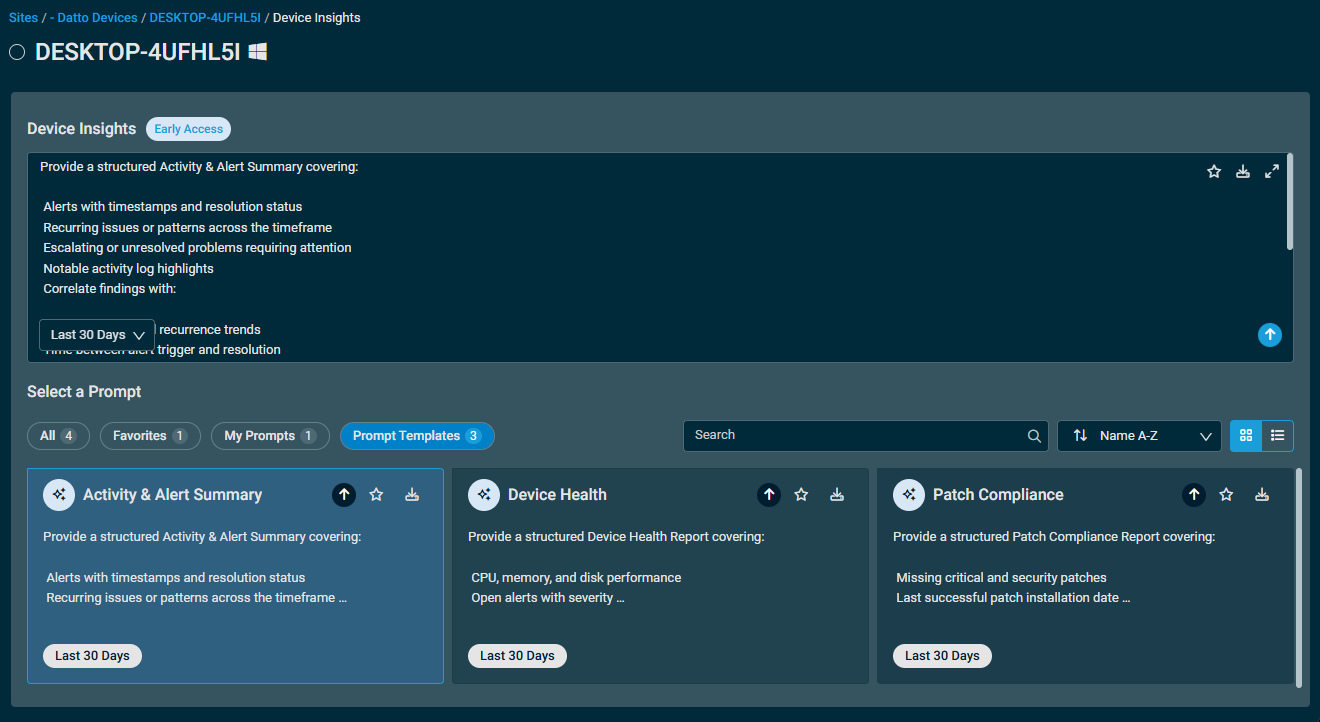
Prompt input area
In the prompt input area, type any natural-language question directly into the prompt input field. For example:
- "Why is this device showing high CPU usage?"
- "Show me all failed patches in the last 14 days."
- "What jobs have run on this device today?"
In addition, configure the Time Range filter using the drop-down menu at the bottom of the prompt input area to set the data collection window.
Prompt selection panel
Below the input area, a library of prompt cards is displayed for quick selection.
Prompts are organized into four tabs:
| Tab | Description |
|---|---|
| All | Displays all prompts contained in the other tabs. |
| Favorites | Displays all prompts you have favorited for quick access. Click the ★ (star) icon on any card to add or remove it from Favorites. |
| My Prompts | Displays all custom prompts you have created and saved. Click the ⋮ (three-dot) menu on any card to edit or delete the prompt. Click the ★ (star) icon on any card to add or remove it from Favorites. |
| Prompt Templates | Pre-built prompts provided by the platform, covering common troubleshooting scenarios. Click the ★ (star) icon to add a template to Favorites, or use the Save to My Prompts option to create an editable copy in My Prompts. |
Each prompt card displays the following:
| Element | Description |
|---|---|
| Title | A short name describing the prompt's purpose. |
| Description | A brief explanation of what the prompt analyzes or generates. |
| Time Range badge | Indicates the default data window (for example, Last 24 Hours, Last 7 Days). |
Running a prompt
To run a prompt to generate device insights, complete the following steps:
- Select a prompt card from the selection panel, or type a free-form question in the prompt input area.
- When selecting a prompt card, the prompt is loaded in the prompt input area together with associated filters. The prompt text can be edited if needed before sending it to the AI.
- Click Run Prompt.
- If using a prompt card, you can run it in its default configuration by clicking the Run Prompt quick action directly on the card.
- The interface will then transition to a split-panel view:
- Left panel (Chat): Displays the conversation thread, including your original prompt and the AI response summary. A follow-up input field at the bottom allows you to refine or drill deeper into the results.
- Right panel (Insight): Displays the generated analysis with a contextual title, structured data tables with status indicators, and recommended actions.
- Once an insight is presented, continue the conversation in the chat panel on the left side to refine, drill deeper, or ask follow-up questions.
To close out your insights session when done, you have the following options:
- Close: Close the session by clicking the X icon in the upper-right corner or Close at the bottom right. This will stop your session and return you to the prompt selection view.
- Download as PDF: Exports the current result, including charts and tables, as a document for record-keeping, internal reporting, or customer presentations.
Prompt templates
Device Insights includes pre-built prompt templates. Kaseya provides these templates ready for you to run as-is, or for use as the foundation for your own custom prompts.
NOTE While you can't directly modify a system prompt, you can select its prompt card to load the prompt input area with its configuration, and then click Save to My Prompts to create an editable copy. Refer to Managing prompt cards.
Managing prompt cards
In addition to the built-in prompt cards, you can create your own cards in order to get consistent, repeatable insights. You can also edit your custom prompts and delete them as needed.
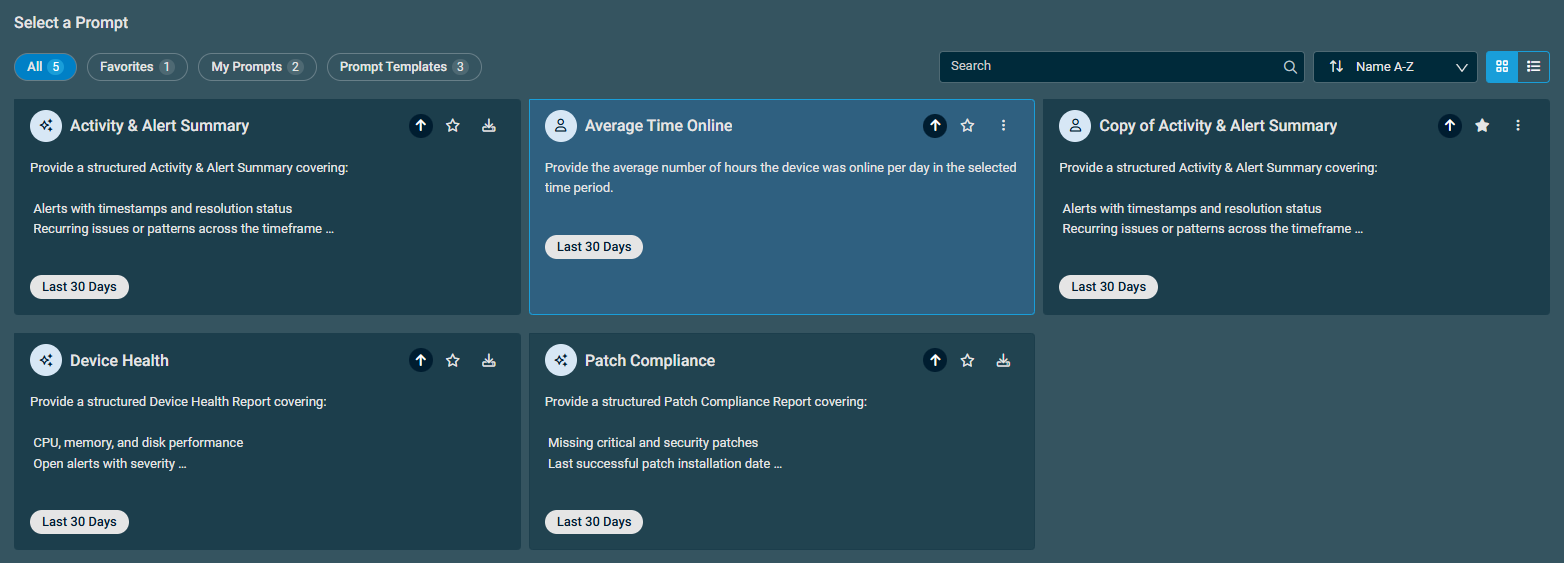
Once prompt cards are created, they will be available to run against all supported devices.
NOTE Custom prompt cards are only visible to the user who created them.
To save a custom prompt as a prompt card:
- Add your prompt text to the prompt input area.
- Click Save to My Prompts in the top right.
- Configure the Prompt Name field. The Description field will contain the configured prompt input and can also be edited at this time.
- Set the default time range using the selector in the description area (24h, 7d, 14d, or 30d). This affects time-based logs such as the Activity Log and Change Log.
- Click Save.
The prompt card will now show in the prompt selection panel with a separate icon to indicate that it is user-created.
Once a prompt has been created, you can mark it as a favorite, edit it, or delete it.
To edit a custom prompt card:
- Click the ⋮ (three-dot) menu on the custom prompt card, and select Edit.
- In the window that opens, you can edit the Prompt Name and Description fields.
- Click Save.
To delete a custom prompt card:
- Click the ⋮ (three-dot) menu on the custom prompt card, and select Delete.
- In the confirmation window, select Remove to permanently delete the prompt card.
Best practices
When using Device Insights, use the following best practices to help you get the most out of your results:
- Use follow-up prompts: After an initial insight is presented, ask follow-up questions to continue the conversation and drill into the specifics (for example, "Show me the patch history for the last 30 days").
- Try free-form questions: Any natural language question about the device can be entered directly in the input area.
- Export for documentation: Use the Download as PDF option to export the output so you can attach insights to ticket summaries, documentation, or customer communications.
Frequently asked questions
Can I use Device Insights on network devices?
No, Device Insights is currently available for Windows devices only (workstations and servers). Support for additional operating systems and device types will be added in future releases.
What does time range mean?
The time range determines how far back Device Insights looks when retrieving time-based data, such as Activity Logs and Change Logs. Prompts support configurable time ranges including 24 hours, 7 days, 14 days, and 30 days. The default is set per prompt and can be changed when editing a custom prompt.
Can I share my saved prompts with team members?
Not currently. Saved prompts are private to each Datto RMM user. The ability to share prompts with team members will be added in a future release.
Can I type my own questions instead of using prompt cards?
Yes. The prompt input area accepts any natural language question about the device. Refer to Running a prompt.


